
Federal Subcontract Flow-Downs: What Changes in Your AV and Shading Scope

Federal subcontract flow-downs change how AV, low-voltage, and electric shading work is reported, accessed, submittalled, and closed out.
Federal subcontract flow-downs change how AV, low-voltage, and electric shading work is reported, accessed, submittalled, and closed out.
For general contractors, prime contractors, and subcontractors working on federal or government-related projects, the practical question is simple:
What obligations reach the AV and shading scope, and who owns each deliverable?
The subcontract controls
A flow-down clause passes an obligation from the prime contract into a subcontract by reference or by attachment. The clause may require the subcontractor to follow a federal requirement, submit records, meet a labor standard, use specific materials, or support the prime’s reporting responsibilities.
The solicitation summary is not the controlling document. The executed subcontract, incorporated terms, referenced exhibits, drawings, specifications, wage determinations, and security requirements control the work.
The current FAR 52.244-6, for example, identifies clauses that may apply to subcontracts for commercial products and commercial services. DoD work may also include DFARS requirements. The applicable set depends on contract type, agency, location, dollar threshold, work classification, and the actual scope.
Read the flow-down exhibit before signing. Confirm what applies. Confirm what does not.
Content Card, Prime Coordination Point
Provide the complete subcontract, flow-down exhibit, drawings, specifications, wage determination, security instructions, and reporting templates before mobilization. The AV subcontractor cannot manage requirements that were not issued clearly.
Eight areas that change the scope
Federal requirements often turn a standard Division 27 or commercial AV scope into a more controlled work package.
- Labor standards: Wage determinations, worker classifications, certified payroll, timesheets, and reporting cadence may apply to installation labor.
- Bonding and insurance: The subcontract may require specific evidence, endorsements, limits, or renewal procedures. The prime and contracting officer should confirm the applicable requirements.
- Security and badging: Crews may need advance approval, background documentation, facility training, escorts, restricted-area procedures, or tool controls.
- Subcontracting plan participation: The prime may need reporting related to subcontracting participation. Do not assume that ownership status creates federal eligibility. Route those questions to the prime, contracting officer, or SBA.
- Domestic preference: Buy American or other domestic-preference provisions may affect displays, racks, cabling, control equipment, motors, power supplies, and other supplied components where applicable.
- Records retention: Payroll, submittals, test records, correspondence, and closeout documents may need to remain available for a defined period.
- Audit and inspection rights: The prime, agency, or authorized representatives may inspect work, records, materials, labeling, and testing.
- Lower-tier flow-downs: If the AV subcontractor engages another installer, electrician, programmer, or shading specialist, applicable requirements may need to continue downstream.
For firms evaluating SAM.gov contracts, registration and eligibility questions belong with SAM.gov, the prime contractor, the contracting officer, or the SBA. They should not be inferred from a project summary or a subcontractor’s marketing profile.
Classify labor before the first crew arrives
An AV technician, low-voltage installer, electrician, or shading installer may be treated differently depending on the contract and the work performed.
The prime should confirm whether the scope falls under construction labor requirements, service labor requirements, or another classification. The applicable wage determination may identify classifications, base wages, and fringe requirements. The subcontractor then needs a matching process for employee records, daily hours, rates, and weekly reporting.
The reporting cadence matters. If the prime submits certified payroll information weekly, the AV subcontractor must collect accurate information on the same schedule. A timecard gathered at the end of the month does not support a weekly reporting process.
Classification questions should go to the prime contractor and contracting officer. Labor compliance questions should be reviewed with qualified counsel or the appropriate government office. Do not select a classification based only on a job title.
Document the work as compliance evidence
Documentation is not only a closeout task. It supports the prime’s ability to demonstrate that the work was performed as specified.
A controlled AV or shading file may include:
- Approved product data and shop drawings.
- Submittal logs with review status and dates.
- Daily reports, timesheets, and certified payroll records where applicable.
- Cable test results and equipment test records.
- Device addresses, termination schedules, and rack elevations.
- Open-wall photographs showing pathways, sleeves, cable routes, and firestopping.
- Labeled and mapped drop schedules.
- Redlined drawings and final as-builts.
- Training records and operating instructions.
- Punch-list responses and acceptance documentation.
Open-wall photographs and labeled as-builts serve two purposes. They support construction coordination, and they provide evidence of what was installed before the work was concealed.
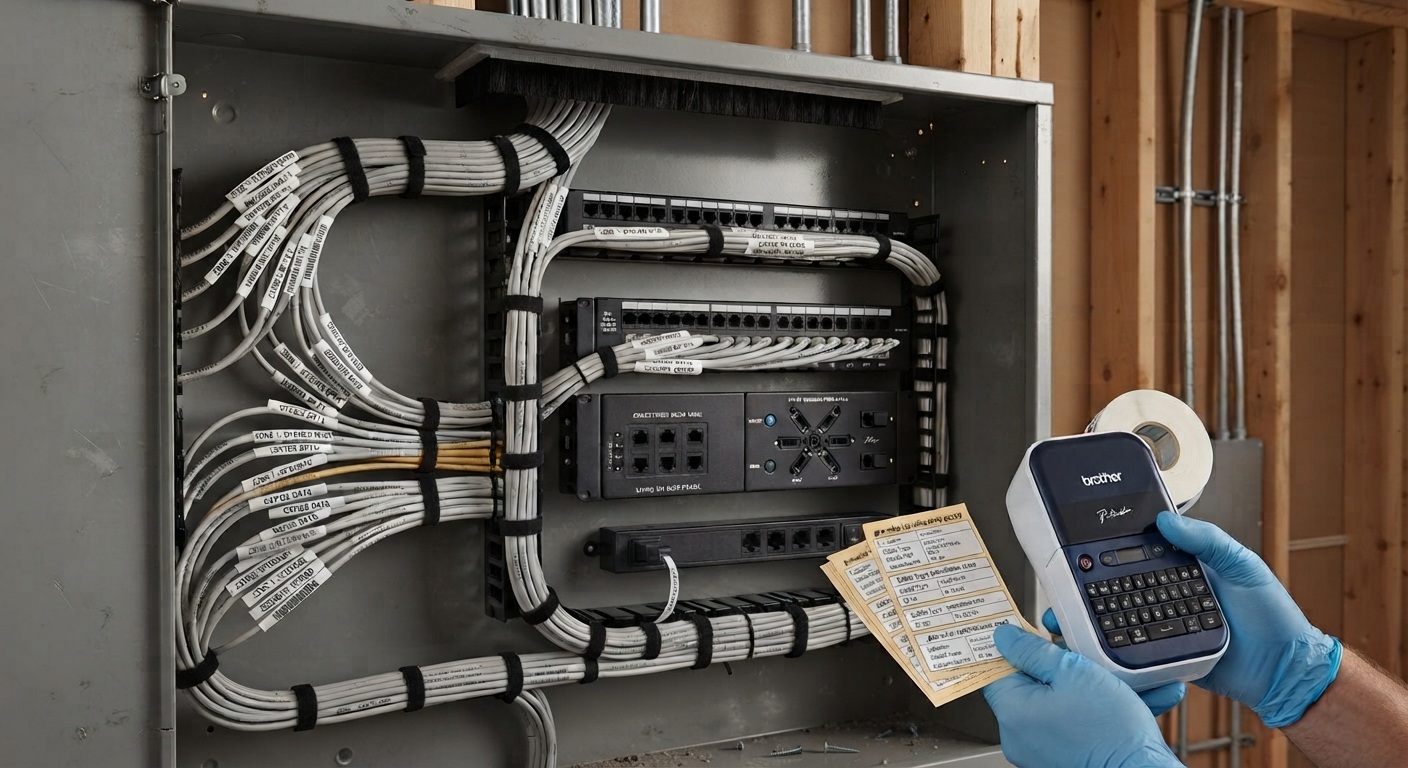
Labeled. Mapped. Photographed. Traceable.
Security changes the installation plan
Occupied facility construction creates additional coordination points. A crew may not be able to enter freely, stage materials in corridors, work after hours, or access every room without an escort.
Badging and access requirements affect:
- Crew size and employee substitutions.
- Lead time for approvals and facility orientation.
- Daily arrival and departure procedures.
- Material staging and tool control.
- Shutdowns, testing windows, and noisy work.
- Storage of drawings, device information, and system credentials.
- Coordination with facility operations and security personnel.
A clear access plan belongs in the project schedule. The prime should identify who submits personnel information, who approves access, and how delays or substitutions are handled.
Write the electric shading boundary
Electric shading is not only a window-treatment item. It can include coordination between architectural pockets, electrical power, low-voltage control wiring, network gateways, keypads, programming, testing, and user training.
A responsibility matrix should identify who owns:
- Pocket dimensions, blocking, and access panels.
- Power circuits, disconnects, and line-voltage terminations.
- Control wiring and pathway requirements.
- Network drops, gateways, and addressing.
- Keypads, control stations, and scene logic.
- Shade measurement, installation, and alignment.
- Programming, commissioning, testing, and training.
- Final documentation and owner turnover.
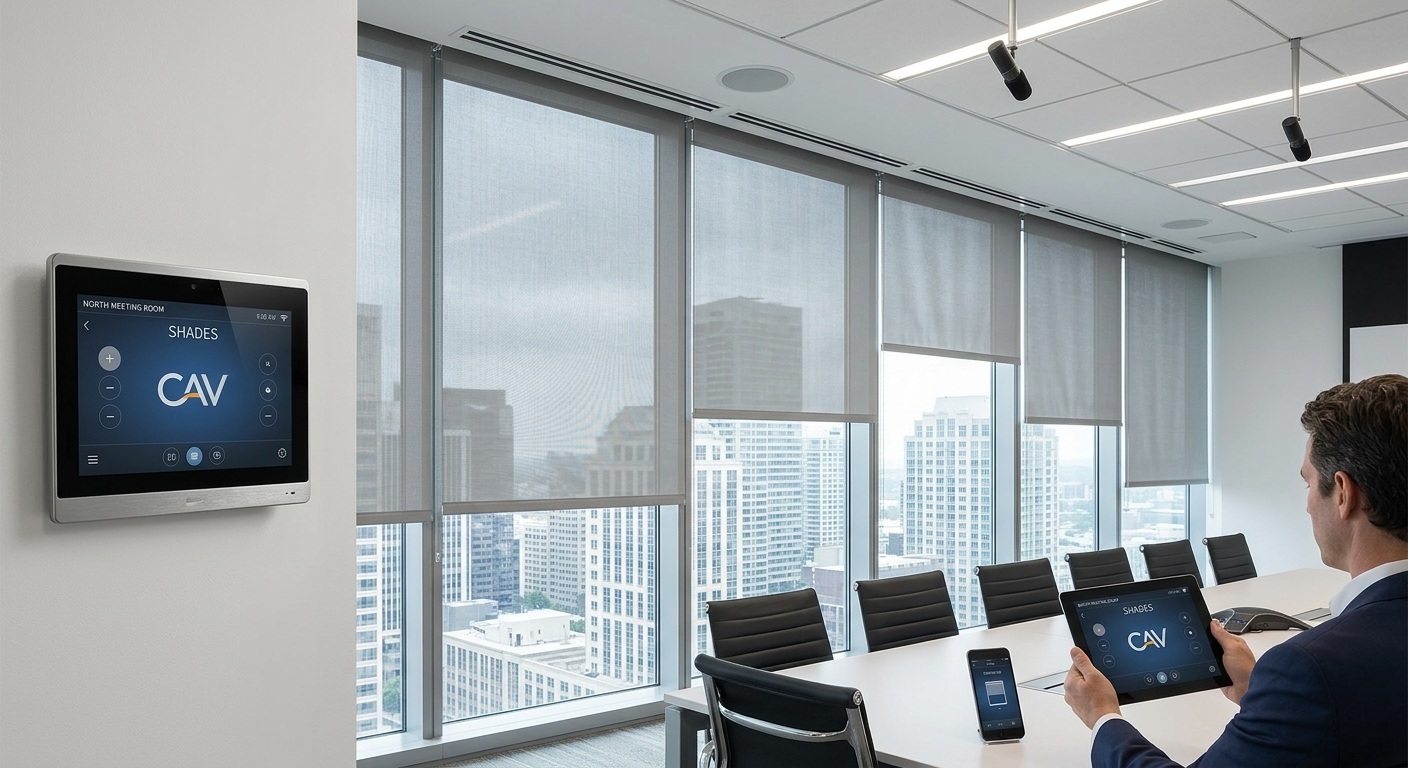
The matrix prevents a common problem: each trade assumes another trade owns the last connection. On a federal-facing project, that gap also affects inspection, testing, schedule reporting, and acceptance.
Match every cabling component
Structured cabling should be treated as a complete channel, not a cable-only purchase.
Use Cat6 for standard 1GbE networks, shorter 10GbE runs, and cost-controlled residential or light-commercial applications. Use Cat6A for designs requiring 10GbE across a full 100-meter channel, dense cable bundles, higher-power PoE, or long-term capacity.
A structured cabling system performs only to the level of its lowest-rated component. The cable, jacks, patch panels, patch cords, connectors, and related channel components must match the selected category.
That requirement belongs in the submittal. It also belongs in the test records and as-built documentation.
Content Card, Submittal Control
Identify the selected category, channel length, component ratings, pathway conditions, labeling method, and testing procedure before installation. A category label on the cable alone does not document the completed channel.
Pre-signature review checklist
For subcontractors
Before signing, confirm:
- The exact AV, low-voltage, structured cabling, and shading scope.
- All FAR and DFARS clauses identified as applicable.
- Contract type and labor classification direction.
- Wage determination and reporting format, if applicable.
- Security, badging, escort, and access requirements.
- Bonding and insurance requirements with the prime.
- Domestic-preference or country-of-origin documentation.
- Required submittals, test records, photographs, and closeout files.
- Inspection, audit, records-retention, and acceptance provisions.
- Responsibility for lower-tier subcontractors.
- Change authorization and schedule-notice procedures.
- Ownership of programming, training, credentials, and final as-builts.
For primes issuing the subcontract
Provide:
- The complete contract documents and flow-down exhibit.
- A scope narrative tied to drawings and specifications.
- A responsibility matrix for AV, electrical, network, controls, and shading.
- The project schedule with access and inspection milestones.
- Wage and labor instructions confirmed by the appropriate parties.
- Security requirements and badging lead times.
- Approved submittal and reporting templates.
- Material-origin requirements where applicable.
- Required labeling, testing, photography, and closeout standards.
- A clear process for changes, substitutions, field conflicts, and acceptance.
Content Card, Prime Coordination Point
Issue one coordinated package. Clear submittals. Coordinated schedules. Defined boundaries. The subcontractor should know what to install, what to document, who approves it, and when each record is due.
Build the closeout before installation
A federal-facing closeout package should not be assembled from memory after the last punch-list item. Build it as the work progresses.
The final package may include approved submittals, equipment schedules, cable test records, labeled rack documentation, drop maps, open-wall photographs, redlines, clean as-builts, programming notes, training records, and completed inspection responses.
For commercial AV systems, the handoff should explain how the system is operated. For electric shading, it should identify zones, controls, schedules, gateways, and normal operating procedures. For structured cabling, it should connect each tested channel to its physical label and drawing location.
The result is a clean transition to the owner, facility team, commissioning group, or next trade.
A controlled process from rough-in to handoff
Carolina AV Group brings more than 30 years of technical leadership to commercial AV, low-voltage, structured cabling, and control work. The process is GC-first:
Plan accurately. Install cleanly. Document the work. Deliver intuitive control.
That means organized submittals, plan and schedule coordination, labeled and mapped drops, open-wall photo documentation, and clean as-built handoffs. It applies to commercial AV installation, pre-wire and low-voltage rough-ins, and integrated control work. The same disciplined documentation supports residential systems through residential AV services.
Carolina AV Group is 100% veteran-owned. That is an ownership fact, not a statement of SBA certification, set-aside eligibility, or federal award status.
If you are issuing or reviewing an AV, low-voltage, structured cabling, or electric shading subcontract in Eastern North Carolina, send the plans, specifications, flow-down exhibit, and schedule through the contact page. We will return a clear scope review, identify coordination points, and organize the next step.


